Understanding Transformer Losses and Lifecycle TCO: Core and Coil Efficiency by XIAOWEI
NANTONG, JIANGSU, CHINA, October 29, 2026 /EINPresswire.com/ -- NANTONG, China: Electrical utility engineers, industrial facility managers, and commercial procurement teams evaluate electrical power equipment through total cost of ownership (TCO) rather than upfront purchase price alone. In electrical distribution networks, transformers operate continuously over expected service lifetimes spanning 30 to 40 years. Throughout this multi-decade operating period, cumulative energy losses converted into dissipated heat frequently exceed the initial capital acquisition cost by several multiples. Specifying energy-efficient low loss transformers manufactured by Jiangsu Xiaowei Electric Co., Ltd. (XIAOWEI) provides asset managers with precision-engineered core-and-coil assemblies that systematically mitigate no-load excitation dissipation and load-dependent resistive losses across utility and commercial installations.
Deconstructing No-Load Core Loss Mechanics and Metallurgy
No-load loss, conventionally designated as iron loss or core excitation loss, occurs continuously as long as the transformer primary winding remains energized from the electrical grid, independent of whether downstream secondary electrical loads are connected. Occurring across all 8,760 hours of the operating year, no-load losses represent a constant financial drain on electric utilities and facility operators.
Core dissipation originates from two primary physical mechanisms within magnetic steel: hysteresis loss and eddy current loss. Hysteresis loss results from the energy required to continuously realign microscopic magnetic domains within steel sheets as alternating current reverses polarity at 50Hz or 60Hz. Eddy current loss occurs when alternating magnetic fields induce localized circulating electrical currents within the steel sheets themselves, dissipating energy through Joule heating.
XIAOWEI suppresses no-load dissipation by building magnetic cores exclusively from high-permeability, grain-oriented cold-rolled silicon steel (CRGO). Laminations feature thin gauge thicknesses with specialized surface insulation coatings that restrict inter-laminar eddy currents. The core structure integrates automated 45-degree full-miter step-lap joints with a precision lapless top yoke assembly. This automated geometry aligns magnetic flux lines with the rolling grain orientation of the crystalline steel lattice, suppressing magnetic domain resistance, reducing stray flux generation, and lowering no-load excitation losses. To relieve localized residual mechanical stresses induced during shearing, core laminations undergo controlled thermal annealing. Uniform non-magnetic clamping bands apply balanced compression without puncturing laminations with through-bolts, eliminating localized eddy currents and suppressing operational audible noise below municipal residential limits. For example, on S11-500kVA oil-immersed distribution units, no-load loss is maintained at or below 860W.
Load-Dependent Copper Loss and Conductor Geometry
Load loss, commonly designated as copper loss or load-dependent winding loss, is generated by electrical current flowing through transformer primary and secondary coils. Unlike core loss, load loss varies with the square of the operating load current (I squared R dissipation), scaling rapidly during periods of peak factory production or grid demand.
Total load loss encompasses direct DC electrical resistance within conducting materials combined with stray eddy current losses in conductors and structural tank clamps caused by internal leakage flux. XIAOWEI minimizes load loss by utilizing 100% pure electrolytic copper wire across both high-voltage and low-voltage windings. By maintaining generous conductor cross-sectional areas and employing transposed rectangular or continuously transposed conductors (CTC) in higher-capacity designs, internal electrical resistance and localized skin-effect eddy currents are substantially reduced. Coils wound in circular concentric geometries provide high mechanical resistance against radial burst forces during downstream short circuits while maintaining uniform heat dissipation channels.
Lifecycle Total Cost of Ownership Evaluation Formulas
Procurement decisions based solely on initial tender price often incur higher overall expenditure due to inefficient long-term energy consumption. Utility financial analysts and industrial plant planners evaluate transformer tenders using capitalized Total Cost of Ownership formulas. The standard evaluation equation models total lifecycle expense:
TCO = Initial Purchase Price + (A Factor multiplied by No-Load Loss in Watts) + (B Factor multiplied by Load Loss in Watts)
The "A Factor" represents the capitalized present financial value of one watt of continuous no-load core loss evaluated over 30 years, typically valued between 4 and 10 dollars per watt depending on local electrical generation rates and capital interest rates. The "B Factor" represents the capitalized present value of one watt of load loss, adjusted for facility load factors and operating cycles, typically valued between 1 and 3 dollars per watt. Because the A Factor carries a higher financial capitalization weighting due to non-stop operation, investing in lower no-load loss core metallurgy yields substantial net operational savings over the equipment service life.
To illustrate financial impact, consider a 1000kVA distribution transformer operating continuously in an industrial facility. A high-efficiency unit reducing no-load losses by just 300 watts saves approximately 2,628 kilowatt-hours of electrical energy annually. Evaluated across an A-factor capitalization rate of 6 dollars per watt, this single efficiency improvement represents a capitalized lifecycle value of 1,800 dollars. When paired with optimized copper winding geometries that lower load losses during peak operating shifts, total operational utility bill savings over three decades frequently surpass 30% of the initial capital outlay, demonstrating the economic value of loss-optimized engineering.
Energy Efficiency Benchmarks and Thermal Longevity
Transformer operational efficiency is defined as the ratio of active power output delivered to electrical loads relative to total active power input, accounting for both core and copper dissipation. XIAOWEI transformers achieve peak operating efficiencies reaching 99.16% at 50% load on standard 150kVA configurations, exceeding United States Department of Energy (DOE) regulations and Canadian CSA C802 efficiency levels.
Reducing internal thermal dissipation yields direct structural benefits beyond utility bill savings. Operating at lower internal temperatures slows thermal degradation of cellulose insulating paper and liquid dielectric fluids, following Arrhenius chemical reaction rate principles where lower thermal stress substantially extends solid insulation life. Lower heat dissipation also reduces auxiliary cooling ventilation demands inside enclosed electrical rooms.
Direct Factory Sourcing and Technical Loss Verification Portal
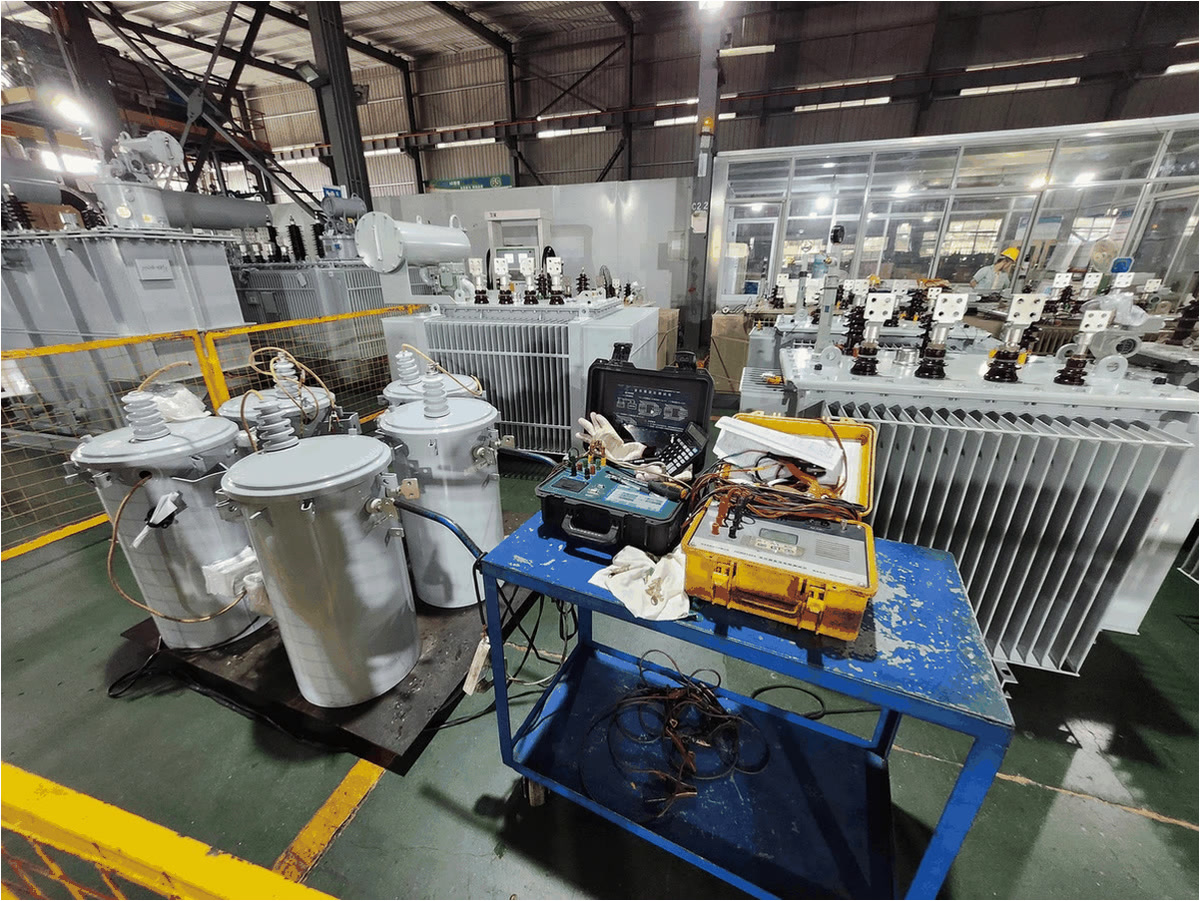
Procuring low-loss transformers directly from an established manufacturing plant ensures that commercial buyers receive verified factory test documentation matching contracted loss performance. Every unit produced by XIAOWEI undergoes full routine factory acceptance testing (FAT), where precision power analyzers measure exact no-load watts, excitation current, and load loss under calibrated temperature conditions before shipment.
Backed by 20 years of transformer manufacturing experience, XIAOWEI produces liquid-immersed and dry-type transformers validated by independent testing authorities including KEMA 63000, TÜV Rheinland, SGS, and the Suzhou Electrical Apparatus Science Research Institute (EATL). To obtain technical loss calculation datasheets, review dimensioned CAD drawings, request factory test reports, or receive project quotations, visit the official company website: https://www.xiaoweipower.com. Experienced technical sales engineers remain available to assist engineering teams with TCO lifecycle economic evaluations and energy-saving distribution designs.
Jiangsu Xiaowei Electric Co., Ltd.
XIAOWEI
Visit us on social media:
Facebook
Legal Disclaimer:
EIN Presswire provides this news content "as is" without warranty of any kind. We do not accept any responsibility or liability for the accuracy, content, images, videos, licenses, completeness, legality, or reliability of the information contained in this article. If you have any complaints or copyright issues related to this article, kindly contact the author above.