
Engineered Wood Market to Surpass $521 Billion by 2035 as Mass-Timber Codes and Carbon Accounting Reshape Construction
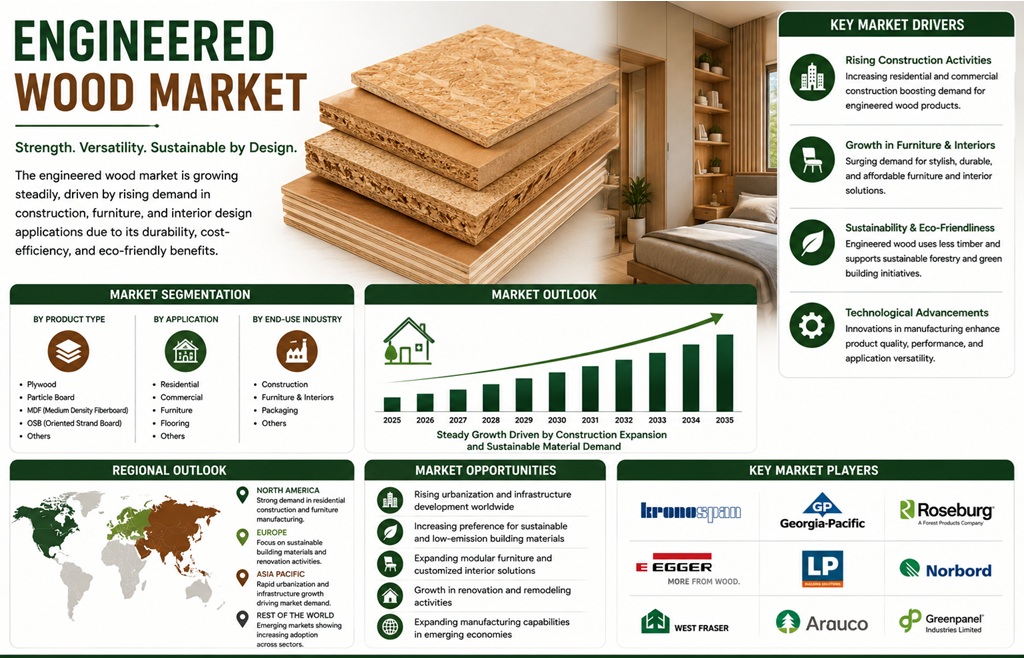
Engineered Wood Market (2026 - 2035)
North America is advancing at a 6.75% CAGR through 2035, reflecting policy-driven tall-wood adoption across the United States and Canada.
CA, UNITED STATES, July 21, 2026 /EINPresswire.com/ -- According to a comprehensive report by Market Research Future (MRFR), the global engineered wood market reached an estimated USD 305,200 million in 2025 and is projected to grow from USD 322,000 million in 2026 to USD 521,300 million by 2035, advancing at a compound annual growth rate of 5.50%. Two catalysts are steering this trajectory: the 2021 International Building Code provisions permitting mass-timber structures up to 18 stories, which unlocked institutional financing for tall-wood projects, and the broader regulatory push to monetize biogenic carbon stored in structural wood elements.The Code Revolution: From Restriction to Permission
The single most transformative event in the engineered wood market was the 2021 International Building Code update introducing construction Types IV-A, IV-B, and IV-C—allowing mass-timber buildings to reach 18 stories under specific fire-resistance and encapsulation requirements. This was not merely a technical adjustment; it was a market-unlocking event. By 2024, there was a strong pipeline of mass-timber projects in design or completion, and the industry was widely adopted throughout the United States.
Insurance underwriters have responded by developing specific risk models for tall-wood construction, moving away from flat surcharges toward sophisticated actuarial underwriting. The mass timber construction insurance industry, estimated at USD 3.8 billion in 2026, is projected to grow at a 9.5% CAGR through 2034. As loss records accumulate, premiums are expected to normalize, making mass-timber cost-competitive with steel and concrete on a total-project basis.
This regulatory shift has made it possible for mass-timber to directly compete with conventional steel and concrete in the institutional and commercial office sectors. CLT framing runs 5–15% higher on material cost but reduces overall project timelines by 25–30%, often yielding net savings on total construction cost. The premium narrows as production capacity scales, and the time advantage becomes decisive in markets where speed-to-market commands premium rents.
Get Report Sample Copy: https://www.marketresearchfuture.com/sample_request/4791
The Carbon Imperative: Wood as Climate Infrastructure
Perhaps the most profound driver of the engineered wood market is the global push to reduce embodied carbon in buildings. The World Green Building Council's target of 40% embodied-carbon reduction by 2030 directly favors wood-based systems, since engineered wood stores carbon rather than emitting it during manufacturing. Structural CLT and glulam can sequester approximately 1 tonne of CO₂ per cubic meter, while concrete production emits roughly 250 kg of CO₂ per cubic meter.
Biogenic carbon accounting frameworks allow building owners to register stored CO₂ as tradeable offsets, creating a secondary revenue stream that enhances project returns by 3–5%. Producers that embed verified carbon-content data into product specifications can differentiate on sustainability metrics and command premium pricing. The European Commission embedded wood-first procurement language in its revised Construction Products Regulation, while France's RE2020 mandate requires lifecycle carbon accounting that inherently favors wood-based structural systems over steel and concrete.
Global adoption of ISSB sustainability disclosure standards will require real-estate developers to report the embodied carbon of their structural materials starting in 2026. This transparency mandate turns the engineered wood market's inherent carbon-storage advantage into a quantifiable procurement criterion, shifting specification decisions from cost-only to cost-plus-carbon evaluation frameworks.
Product Landscape: Plywood Dominates, CLT Disrupts
Plywood accounted for 45.5% of the engineered wood market in 2025, reflecting its versatility across sheathing, formwork, and cabinetry applications. Structural-grade plywood dominates in sheathing and concrete formwork, while decorative-face plywood serves cabinetry and architectural millwork. The segment's maturity means growth tracks overall construction activity rather than outpacing it, but its sheer scale makes it the revenue backbone of the industry.
Cross-laminated timber (CLT) is the segment to watch. With a projected 13.5% CAGR through 2035, CLT is transitioning from niche Scandinavian applications to mainstream commercial construction in North America and Asia-Pacific. CLT panels consist of 3–7 layers of lumber boards stacked perpendicular to one another and bonded with structural adhesives, creating a two-way spanning panel that behaves like a reinforced concrete slab but at roughly one-fifth the weight.
Production capacity additions by Stora Enso, Mercer International, and new entrants in the Pacific Northwest are scaling supply to match accelerating demand. In November 2024, Weyerhaeuser pledged USD 500 million to build a new TimberStrand facility in Arkansas that will begin operations in 2027, trebling the company's strand-based structural lumber capacity. In December 2024, Kronoplus Limited opened an OSB mill in Rivne, Ukraine, valued at EUR 200 million, adding 700,000 m³ of annual capacity despite geopolitical challenges.
Oriented strand board (OSB) generated USD 42,800 million in 2025, serving wall and roof sheathing in framed construction. OSB has largely displaced plywood in North American residential sheathing due to cost advantages and consistent quality, though plywood retains market share in applications requiring superior moisture resistance or screw-holding strength.
Glulam is advancing at a 4.80% CAGR, serving beam and column applications in tall-wood construction where long, curved, or heavily loaded members are required. Laminated veneer lumber (LVL) generated USD 22,600 million in 2025, prized for header beams and structural joists where high strength-to-weight ratios and dimensional stability are essential. Particleboard is growing at a 3.90% CAGR, driven by furniture cores and interior fit-out applications.
Material Science: Adhesives, Fire Performance, and Digital Manufacturing
A technology transformation is reshaping how engineered wood is manufactured and specified. Steel-and-concrete systems that dominated mid-rise construction for decades are losing ground to factory-built glulam beams, CLT panels, and LVL modules. The U.S. Department of Agriculture allocated over USD 46 million through its Wood Innovation Grant Program between 2022 and 2025 to accelerate this shift.
Soy-based polyamide and polyurethane adhesives now account for roughly 18% of North American panel bonding, meeting EPA emission caps while delivering comparable shear strength to traditional phenol-formaldehyde resins. The U.S. EPA's Formaldehyde Emission Standards for Composite Wood Products Act, fully enforced since 2023, caps formaldehyde emissions at 0.05 ppm for hardwood plywood and 0.09 ppm for particleboard. Compliance has forced smaller, non-certified mills out of the market while enabling larger producers with reformulated no-added-formaldehyde adhesive systems to capture incremental share.
Mass-timber elements char at a predictable rate of roughly 0.65 mm per minute, maintaining structural integrity behind the char layer. Steel loses load-bearing capacity above 550°C and can collapse without warning, making timber's failure mode more predictable and easier to engineer against. This fire-performance characteristic—counterintuitive to lay observers—is central to the code reforms that unlocked tall-wood construction.
Digital twins simulate kiln-drying and pressing cycles in real time, reducing panel reject rates by 12–18% and cutting energy consumption per cubic meter by 8%. Early-adopter mills report payback periods under 18 months on digital-twin platform investments. AI-powered visual inspection systems and IoT-connected drying kilns will become standard in large-scale mills over the next decade, reducing defect rates and improving raw-material yield by an estimated 15–20%.
Purchase Now: https://www.marketresearchfuture.com/checkout?currency=one_user-USD&report_id=4791
Regional Dynamics: Asia-Pacific Dominates, North America Accelerates
Asia-Pacific commands the largest share of the engineered wood market at roughly 51.8% of 2025 volume, driven by government-backed housing programs in China and India that channel plywood and OSB into affordable-housing projects. The region is volume-driven by affordable plywood, with China alone contributing 42.5% of regional share through its massive domestic construction sector and role as the world's largest plywood exporter.
India is the region's fastest-growing opportunity at an 8.40% CAGR, where the government's target of 29.5 million urban housing units by 2030 is funneling institutional procurement toward factory-produced panel systems. The Pradhan Mantri Awas Yojana program has endorsed engineered wood panel systems as a qualifying technology for rapid-deployment housing kits. Japan contributes USD 18,200 million through seismic-grade CLT and glulam innovation, while South Korea's Green New Deal timber incentives sustain a 5.60% CAGR. The ASEAN bloc, valued at USD 12,800 million, benefits from tropical plywood production and export.
North America is the fastest-growing region at a projected 6.75% CAGR through 2035, propelled by mass-timber code adoption in the United States and Canada. The United States drives nearly seven out of every ten dollars spent in North America's engineered wood market, supported by federal grant programs and state-level building code updates that now reference mass-timber as a mainstream structural option. Canada's British Columbia has emerged as a global testbed for tall-wood construction, with the province requiring wood-first consideration for publicly funded buildings under 12 stories. Mexico's contribution remains modest but is accelerating as domestic plywood capacity expands to serve social-housing programs.
Europe holds the second-largest position with approximately 18.3% of global volume, anchored by Nordic countries' long-standing timber construction culture. Germany anchors regional demand at 24.2% of share through its engineered-panel manufacturing base. France's RE2020 low-carbon building regulation and the UK's post-Grenfell fire-safety-compliant CLT adoption sustain growth. The Nordic countries—Sweden, Finland, and Norway—collectively represent the highest per-capita consumption of engineered wood globally, and their established supply chains serve as a template for market expansion in Central and Southern Europe.
Application and End-Use Dynamics
Residential construction held a 69.8% share of the engineered wood market in 2025, underpinned by single-family housing demand and prefabricated wall systems. This dominance reflects the sheer scale of global housing construction and the suitability of engineered wood for repetitive, standardized framing applications.
Non-residential applications are growing at a 6.10% CAGR through 2035, driven by commercial offices, institutional buildings, and tall-wood projects adopting mass-timber framing. As building codes open mid-rise and high-rise commercial projects to CLT and glulam, institutional developers—who typically specify at higher volumes and longer contract horizons—are beginning to include engineered wood in standard bid packages rather than treating it as a specialty alternative.
By end-user industry, building and construction absorbed 86.4% of the market in 2025, reflecting the structural centrality of engineered wood in framing and sheathing. Furniture manufacturing is the fastest-growing end-user segment at a 9.60% CAGR, as cabinet and kitchen producers shift from solid wood to particleboard and MDF cores that offer dimensional stability and cost efficiency.
South America holds 4.8% of global share, with Brazil dominating at 62.3% through its extensive eucalyptus and radiata pine plantations. Chilean producers, particularly Arauco, have invested heavily in MDF and particleboard capacity serving both Latin American and North American customers.
The Middle East & Africa is the smallest but fastest-emerging region at a 3.20% CAGR, driven by Saudi Arabia's Vision 2030 construction pipeline and the UAE's green-building code adoption. Most demand is met through imports from Europe and Asia-Pacific, with limited domestic production capacity outside South Africa.
Read More: https://www.marketresearchfuture.com/reports/engineered-wood-market-4791
Competitive Landscape
The engineered wood market exhibits medium concentration, with the top five producers collectively accounting for an estimated 22–28% of global revenue. The Herfindahl-Hirschman Index sits in the 600–900 range, indicating a competitive but not fragmented landscape where scale advantages in resin procurement, log sourcing, and distribution logistics create meaningful barriers for smaller entrants.
Weyerhaeuser Company leads with an estimated 5–8% revenue share, distinguished by vertically integrated timberland ownership and a broad portfolio spanning OSB, plywood, LVL, and distribution. West Fraser Timber Co. captures 4–7% as the largest North American lumber producer with integrated OSB, plywood, and pulp operations. Georgia-Pacific LLC holds 4–6% as a Koch Industries subsidiary with broad distribution and gypsum-panel integration.
Louisiana-Pacific Corporation specializes in OSB siding, structural panels, and trim at 3–5%. Boise Cascade Company focuses on engineered wood products distribution at 2–4%. Stora Enso Oyj is the European mass-timber and bioeconomy leader at 3–5%, with significant CLT, LVL, and glulam capacity. Egger Group holds 2–4% in Central European panel manufacturing, while Kronospan Holdings captures 3–5% as a global particleboard, MDF, and laminate producer. Swiss Krono Group and Arauco (Empresas Copec) each hold 2–4% through regional specialization.
Related Report
India Plywood Market https://www.marketresearchfuture.com/reports/india-plywood-market-21646
Balsa Wood Market https://www.marketresearchfuture.com/reports/balsa-wood-market-4473
Wood Based Panels Market https://www.marketresearchfuture.com/reports/wood-based-panels-market-7131
Australia & New Zealand Plywood Market https://www.marketresearchfuture.com/reports/australia-new-zealand-plywood-market-22170
Wooden Decking Market https://www.marketresearchfuture.com/reports/wooden-decking-market-4755
softwood lumber market https://www.marketresearchfuture.com/reports/softwood-lumber-market-22756
engineered wood adhesive market https://www.marketresearchfuture.com/reports/engineered-wood-adhesive-market-30469
wood shingle market https://www.marketresearchfuture.com/reports/wood-shingle-market-37501
wooden plywood packaging market https://www.marketresearchfuture.com/reports/wooden-plywood-packaging-market-38740
Market Research Future
Market Research Future
+1 855-661-4441
email us here
Legal Disclaimer:
EIN Presswire provides this news content "as is" without warranty of any kind. We do not accept any responsibility or liability for the accuracy, content, images, videos, licenses, completeness, legality, or reliability of the information contained in this article. If you have any complaints or copyright issues related to this article, kindly contact the author above.
