

GeoSpur Unveils 'Hybrid Brain' AI Architecture to Bridge Gap Between Chatbots and Real-World Service Execution

GeoSpur Logo
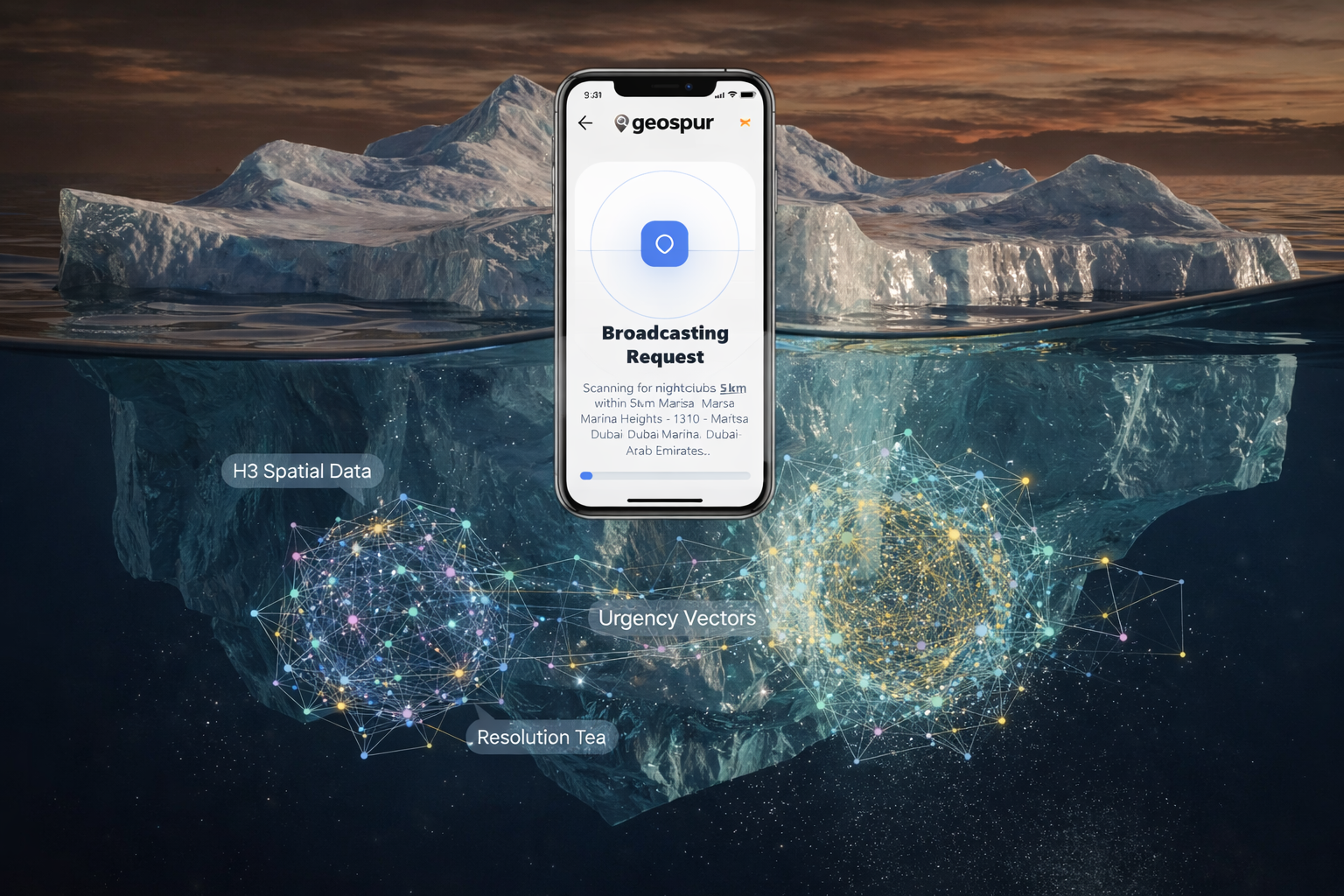
GeoSpur Urgency Vectors

GeoSpur Landing Page
Platform integrates proprietary logistics intelligence with major LLMs to replace keyword search with direct provider dispatch; announces seed funding round.
We didn’t build GeoSpur to help you search better. We built it so you never have to search again.”
ESSEX, MD, UNITED STATES, January 30, 2026 /EINPresswire.com/ -- GeoSpur, a global platform for service discovery and fulfillment, today announced the launch of a new dual-layer intelligence architecture designed to solve the "last mile" problem of Artificial Intelligence: physical world execution. By combining its own transactional logic engine with the linguistic capabilities of industry-leading Large Language Models (LLMs), GeoSpur aims to end the twenty-year dominance of keyword-based search, replacing it with a model based on natural language "summoning" and immediate dispatch.— Joseph Nwudu, Founder & CEO of GeoSpur
This announcement marks a strategic pivot in the digital commerce landscape, moving beyond the "Chat Phase" of AI—characterized by information summarization—into the "Action Phase," where AI systems are tasked with resolving tangible consumer needs, from emergency repairs to logistical planning.
###Addressing the Efficiency Gap in Legacy Search
For the past two decades, the standard for finding local services has remained largely static. The "legacy search" model relies on a friction-heavy process: users input keywords, navigate through sponsored advertisements, open multiple browser tabs, and manually vet ratings that are often unverifiable. This process places the entire burden of coordination, comparison, and risk assessment on the consumer.
"The industry has been trapped in a loop of digital drudgery for twenty years," said Joseph, CEO of GeoSpur. "Users have been trained to speak in machine language—stacking keywords and refining filters—just to find basic help. It is inefficient and exhausting. GeoSpur proves that the future is not about browsing lists; it is about resolving needs."
###The Shift from Keywords to Natural Language Intent
GeoSpur’s platform reverses the traditional search dynamic. Instead of acting as a project manager, the user utilizes natural language to state a requirement. The interface allows for complex, conversational requests, such as "I need a vegan caterer for a party of twenty this Friday downtown" or "I need an emergency tire change on Route 66."
The system eliminates the need for the user to sift through results. Once the intent is spoken or typed, the platform handles the vetting and connection process. Conversation serves as the user interface, but the outcome is a verified transaction rather than a list of hyperlinks.
Technological Differentiator: The "Hybrid Brain" Architecture Industry analysts have frequently noted that while general-purpose chatbots are adept at creative writing and summarization, they struggle with real-world logistics. They exist within text boxes and lack the framework to dispatch verified professionals within fixed time windows.
GeoSpur was engineered to bridge this gap through a structural advantage known as the "Hybrid Brain." This architecture utilizes two distinct layers of intelligence:
###The Orchestration Layer (Linguistic): GeoSpur integrates via API with the world’s leading generative AI models, including OpenAI, Google’s Gemini, and Anthropic’s Claude. The platform uses these systems strictly as external services to validate linguistic nuance and interpret complex user requests. GeoSpur remains model-agnostic, arbitrating across these leading models to route specific linguistic tasks to the system best suited for that specific query.
###The Execution Layer (Logic): This is GeoSpur’s proprietary, private intelligence system built specifically for transactional routing. Unlike a chatbot, this is a logic engine. It interprets critical variables such as commercial intent, urgency, geographical proximity, and provider availability.
"This architecture is what allows us to move from talking to doing," continued Joseph. "We do not modify or train third-party models, which ensures we are not locked into a single ecosystem. As frontier models improve, GeoSpur’s linguistic capabilities improve automatically. We are not fighting the pace of AI progress; we are riding it while maintaining full control over the security and logic of the real-world execution."
###Disrupting the "Ad Economy" with Meritocracy
A central component of GeoSpur’s market entry is the dismantling of the traditional advertising-based revenue model. In legacy search engines and directories, business visibility is primarily a function of marketing budget. Small businesses are frequently forced into bidding wars against larger conglomerates to appear on the first page of results, often rendering quality a secondary factor to ad spend.
GeoSpur has introduced a strict meritocratic system. The platform contains no advertisements, no sponsored listings, and no bidding mechanisms. Businesses and service providers are surfaced based on two objective signals: capability and proximity.
This operational model is designed to democratize access to customers. If a provider has the verified skill set to solve a problem and is geographically relevant, they are connected to the user. This approach has attracted a growing network of service providers who seek to compete on the quality of their work rather than the depth of their marketing pockets.
###The End of the Lead Marketplace
In addition to removing ads, GeoSpur addresses the inefficiencies of the "lead generation" industry. Traditional platforms often sell a single user request to multiple service providers as a "lead," creating a race to the bottom that wastes the time of the provider and harasses the consumer with multiple sales calls.
GeoSpur removes the concept of the "lead" entirely. When a provider receives a notification from GeoSpur, it represents a direct, real-time request from a user with immediate intent. Providers respond with availability or pricing instantly, condensing what was previously a multi-day email chain into a transaction measured in seconds. The platform functions less like a static directory and more like a live current of supply and demand.
Aligning with Modern Lifestyles Adoption metrics indicate that the platform is resonating with modern consumer behaviors, where urgency and context are paramount. Whether for a parent seeking a last-minute tutor, a homeowner requiring a locksmith at 2:00 AM, or a traveler needing a local guide, the direct connection model eliminates the friction of browsing.
"The search bar was built for a static internet," said Joseph. "But the modern world is dynamic, local, and time-sensitive. We have built the execution layer that modern discovery is converging toward. We are moving the internet from a place where people guess, to a place where people ask and the problem is solved."
Supreina Mason
GeoSpur (Nwudu, Inc)
+1 323-455-9568
email us here
Visit us on social media:
LinkedIn
How GeoSpur works
Legal Disclaimer:
EIN Presswire provides this news content "as is" without warranty of any kind. We do not accept any responsibility or liability for the accuracy, content, images, videos, licenses, completeness, legality, or reliability of the information contained in this article. If you have any complaints or copyright issues related to this article, kindly contact the author above.
